 Skip to content

A single negative page or review can sit on Google for months. You don’t plan for it. You don’t see it coming. But once it lands, it follows you everywhere, your name, your brand, your work. You open Google hoping the result finally dropped to page two. It didn’t. It’s still there, holding space it never earned.
That moment hits differently. It feels unfair, and it is. But you’re not stuck with it. Most negative results can be removed, and the ones that can’t still lose their power when you learn how to push them down.
This guide shows you what actually works, what wastes your time, and what to do next when a single page starts telling the wrong story about you.
What Counts as a “Negative Search Result” on Google?
Before you fix anything, you need to know what you’re up against. A negative result isn’t always dramatic. Sometimes it’s a tiny line in an old article. Sometimes it’s a forgotten blog post that suddenly ranks again. Sometimes it’s a complaint on a site you’ve never heard of.
It can be:
- An old news story that refuses to fade
- A blog post written in frustration
- A complaint buried on a consumer site
- A PDF indexed by accident
- A social media post that took off for the wrong reasons
- A third-party listing you never approved
- A Google review that shows up even when someone searches only your name
Anything that shows up on page one and makes people doubt you, that’s a negative result. That’s what you’re fighting.
Can You Actually Remove Negative Search Results From Google?
Sometimes yes. Sometimes no. It depends on what the page is, who controls it, and whether it breaks Google’s rules.
If you’re hoping for a magic “delete” button, Google doesn’t work that way. The internet keeps receipts. But that doesn’t mean you’re stuck.
There are two paths you can take:
Removal — when the content violates Google’s policies or the law.
Suppression — when the result is allowed to stay online, but you push it down so far it stops hurting you.
Removal feels final. Suppression feels like taking back control. Both work in different moments. The key is knowing which fight you’re in before you spend time on the wrong one.
When Will Google Remove a Negative Result? (The Exact Conditions)
Google doesn’t delete something just because it’s unfair or embarrassing. It removes content only when the page crosses a line. If you can show that line was crossed, Google acts quickly. If you can’t, the result stays and you shift to suppression.
Here’s what Google will consider for removal:
- Is the content illegal?
- Is it harassment or doxxing?
- Does it expose private personal data? (address, ID number, medical info)
- Is it explicit and shared without consent?
- Is someone pretending to be you? (identity theft or impersonation)
- Does it violate Google’s own removal policies?
When the harm is clear, Google steps in. Your job is to show exactly where the line was crossed, nothing vague, nothing emotional, just the facts that prove the page shouldn’t be there.
How to Remove Negative Search Results From Google? (Step-by-Step)
When a page crosses the line and qualifies for removal, you can take it straight to Google. The process isn’t complicated, but it needs clarity. Google won’t guess your situation. You have to show it.
Here’s how to do it the right way:
- Identify the exact URL hurting your reputation.
Don’t send Google your whole search results page. Pick the one link causing the damage. - Choose the correct Google removal form.
Google has different forms for harassment, doxxing, impersonation, explicit content, and personal data exposure. The wrong form slows everything down. - Describe the harm clearly.
No long stories. No emotion. One sentence that explains what happened and why the content violates Google’s rules. - Add evidence if you have it.
Screenshots, ID documents, legal reports, anything that proves the issue isn’t vague or speculative. - Wait for Google’s review.
Sometimes it’s quick, sometimes it’s not. But if the violation is real, Google usually responds fast.
What matters most is clarity. The cleaner your explanation, the easier it is for Google to act.
What If Google Refuses to Remove the Result?
Sometimes Google says no. Not because the page is fair, but because it doesn’t clearly violate a policy. When that happens, the fight shifts. You stop trying to delete the result and start building something stronger above it.
Here’s what actually works:
- Improve stronger pages to outrank the negative one.
Google rewards relevance and trust. If you give it better options, it listens. - Create content that shows who you really are.
When people search your name or business, they should see your work, not a moment taken out of context. - Strengthen profiles that already hold authority.
LinkedIn, your website, your business profile, high-trust directories, these rise quickly once optimized. - Use PR, citations, and branded content to shift attention.
One solid mention on a strong site can push an unwanted page down several positions. - Use social proof to change the story around your name.
Reviews, testimonials, public feedback, when people see real experiences from real customers, it weakens the impact of the negative result instantly. - Push down the unwanted link with consistent relevance signals.
Google doesn’t hide pages. It simply ranks what it finds more useful.
If Google refuses removal, you’re not out of options, you’re just in a different chapter. The goal becomes simple: build something so trustworthy, so complete, so accurate, that the negative result loses its place.
How Long Does It Take to Push Down a Negative Result?
There’s no single timeline. Some pages drop fast. Others cling to page one like glue and refuse to move. The difference rarely comes from luck, it comes from the plan behind the work.

Here’s the reality:
- Fast wins
If the negative result is weak, old, or rarely clicked, stronger pages can outrank it in a matter of weeks. Sometimes even days. - Slow wins
If the page has authority, backlinks, or constant organic traffic, it takes longer to push it aside. You’re not fighting the content, you’re fighting the signals holding it in place. - What blocks progress
A thin website, no branded content, inconsistent publishing, or lack of trust signals all slow the recovery. Google can only work with what you give it.
Some results fall quickly. Others don’t. But every negative page loses power once you build something more relevant, more trusted, and more reflective of who you are.
Once your search results reflect who you are, the next step is attracting the right audience. Inbound methods do this without force. This guide on inbound marketing lead generation strategies shows how trust-driven content turns visibility into real opportunities.
What Makes a Google Review Removable?
Not every harsh review is removable. Some stay because they reflect a real experience. But when a review crosses the line, Google steps in. And that’s when you have a real chance to clear your page.
Here’s what Google flags as violations:
- Fake reviews
Someone who never interacted with your business leaves a rating out of spite or confusion. - Reviews from competitors
A rival trying to hurt your reputation instead of earning their own. - Reviews filled with hate speech
Anything discriminatory or abusive is against Google’s rules. - Reviews that expose private personal information
Phone numbers, addresses, medical details, none of this belongs in a review. - Reviews unrelated to the actual experience
Complaints about politics, pricing in another country, or issues that never happened at your business. - Threats or harassment
Anything meant to intimidate, scare, or pressure you.
If the review doesn’t come from a real customer or breaks these rules, you’re not powerless. You have a path to get it removed.
How to Remove Negative Reviews From Google Search Results?
Once you know a review breaks the rules, don’t argue with the person who wrote it. Go to Google instead. The process is simple, but it only works if you stay clear and factual.
Here’s what to do:
- Open your Google Business Profile.
Log in to the account that manages your business on Google. - Find the review that’s causing the damage.
Go to the Reviews tab and locate the exact one you want removed. - Click “Flag as inappropriate.”
This tells Google the review might violate their policies and needs a closer look. - Explain the violation in plain language.
Point to the exact issue: “This review contains personal information,” or “This reviewer has never been a customer and is a competitor.” - Add proof if you have it.
Screenshots, receipts, chat history, booking records, anything that shows what really happened.
Google wants facts, not emotion. The clearer you show what went wrong and how the review breaks their rules, the stronger your removal request becomes.
What Happens If Google Doesn’t Remove the Review?
Sometimes Google keeps the review up even when it feels unfair. That moment stings, but it’s not the end of the story. You still have options, and each one helps you take back control.
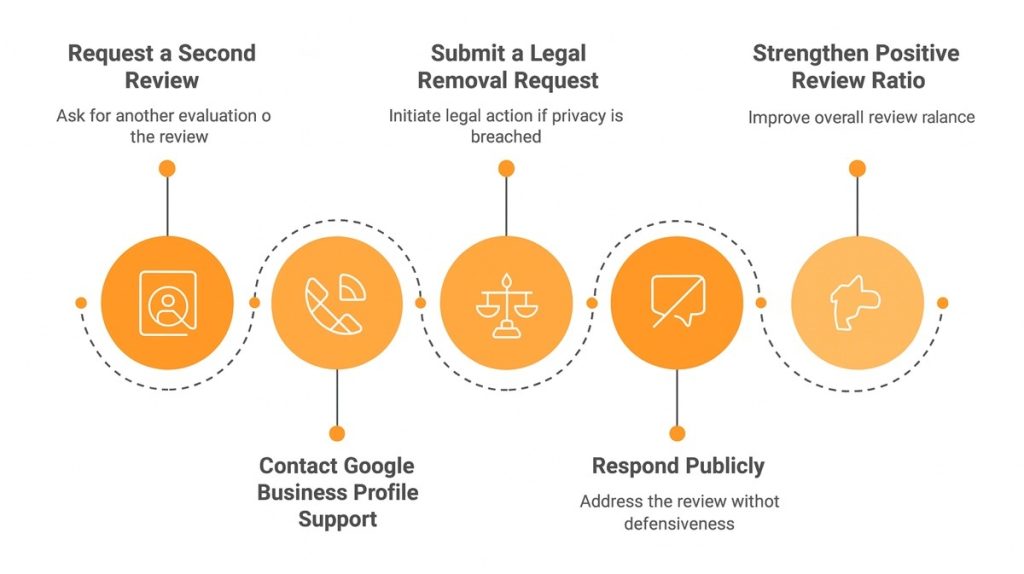
Here’s what you can do next:
- Request a second review.
If the first rejection felt rushed or unclear, submit the request again with sharper details. - Contact Google Business Profile support.
A support agent can look deeper into the case and flag issues the automated review may have missed. - Submit a legal removal request if privacy was violated.
If the review exposes personal data or crosses legal boundaries, Google treats it differently. - Respond publicly — without sounding defensive.
Keep it simple: acknowledge the concern, show what steps you took, and stay calm. People read the response more than the review itself. - Strengthen your positive review ratio.
A single bad review loses its impact when it sits among real experiences from real customers.
One bad review doesn’t define your business, but your response does. And the way you handle it tells future customers far more than the review ever could.
How Do You Suppress a Negative Review So It Stops Hurting Your Reputation?
If a review can’t be removed, the next move is simple: make it irrelevant. One review only has power when nothing stronger stands beside it. Once you build momentum, the bad one fades into the background where it belongs.
Here’s what actually works:
- Ask real customers for honest reviews.
People who already trust you are usually happy to share their experience, they just need to be asked. - Focus on frequency, not volume.
A steady flow of new reviews tells Google your business is active, and it pushes older complaints down the list. - Spread reviews across multiple platforms.
Facebook, Trustpilot, Yelp, industry sites, the more balanced your reputation becomes, the less impact one negative review has. - Fix the root issue so new reviews don’t repeat the same complaint.
When the pattern stops, the damage stops.
People don’t judge you by the bad review, they judge you by what came after it.
A strong cleanup strategy works faster when your business is already active online. If you need a clearer plan for building visibility, this guide on how to market your business online breaks down practical steps that help Google trust you more.
What Should You Fix First When Negative Results Hurt Your Business?
When a negative result starts shaping how people see you, the first instinct is panic. But the fastest way to regain control is to strengthen the places where people already look for answers. A strong presence softens the blow. A weak one makes every hit feel heavier than it should.
Start here:
- Your Google Business Profile
Complete it, update it, and keep it active. This profile often becomes the first thing people trust. - Your branded search results
Make sure your name or business brings up pages that reflect your real work, not an old issue. - Your website’s trust signals
Clear information, reviews, case studies, contact details, real people behind the brand — all of this builds confidence. - Your social media visibility
Active accounts tell Google and your audience that you’re present and legitimate. - Your review-to-response ratio
A thoughtful response to a bad review can calm the impact more than the review itself.
If your online presence is weak, one negative page hits harder. Strength makes you resilient, and it gives Google more reasons to push the negative result down.
When Do You Actually Need Professional Help?
Most people try to handle reputation issues on their own at first, and that’s normal. But there’s a moment when the problem outgrows DIY fixes. That’s when the damage reaches your work, your clients, or your ability to move forward, and waiting becomes the biggest risk.
You need support when:
- Multiple negative results start stacking up
One page is stressful. Three or four can reshape your entire search presence. - Legal issues are involved
Defamation, impersonation, stolen content, these need more than a simple removal request. - You’re hit with fake review attacks
A cluster of sudden 1-star reviews isn’t random. It’s coordinated, and it needs a coordinated response. - Your reputation is being affected in different languages or regions
International damage spreads faster, and it doesn’t fix itself. - Suppression is too slow and the page is harming your work
When a single link starts costing you customers or opportunities, speed matters.
When negative results spread across platforms, you need a unified message that holds your brand together. Fragmented communication slows recovery, and when a single page starts threatening your work, an integrated marketing communications strategy becomes essential, that’s the moment to bring in help and protect what you’ve built.
Explore this guide to affordable brand voice development companies in US.
Final Thought
Taking back your search results doesn’t erase the past. It does something better. It gives people the chance to see you clearly again, without the noise, without the distortion, without the one moment that tried to speak louder than your entire body of work.
The goal isn’t to hide from the internet. It’s to make sure the first thing people see is the truth. Not a single bad review. Not someone’s anger on a random blog. Not a page that misunderstood you.
When you control your search results, the story shifts back into your hands. And that’s where it belongs.
FAQs
How do I get my name removed from online articles?
You can’t delete someone else’s article yourself, but you can remove it if it breaks laws or Google’s rules. Start by checking if the article contains false claims, private information, harassment, or anything that puts you at risk. If it does, you can request removal through Google or contact the publisher directly with proof. When the content is allowed to stay, your next move is suppression, building stronger, trusted pages that climb above the article until it loses visibility.
How long does a negative result stay on Google?
As long as the page exists. Google doesn’t set an expiration date. A link can stay on page one for years if nobody challenges it. But when you build stronger pages, updated profiles, real content, credible mentions, the negative result starts to drop. Sometimes it falls fast. Sometimes it fights to stay. The pace always depends on the strength of what you build next.
What is the fastest way to clean up my search results?
Target the pages that already have authority. Your website, Google Business Profile, LinkedIn, reputable directories, press features, these rise quickly when optimized. Strengthen them, publish new credible content, and tie everything together with consistent branding. If you do it right, Google replaces the negative result with what’s more accurate and more useful.
How do I remove outdated or old information from Google Search?
If the information is outdated, irrelevant, or no longer true, you can use Google’s “Outdated Content” tool to request removal. If the site owner updates or deletes the page, Google usually follows. When the page is still online and Google rejects the request, your only option is suppression. Push the old result out of sight by building content that reflects your current reality.
How do I scrub my personal information or address from the internet?
Start with Google’s “Remove Personal Data” form. You can request removal for exposed home addresses, phone numbers, government IDs, medical details, or anything that puts your safety at risk. Then contact the websites hosting the data and ask them to take it down. The final step is protection: tighten privacy settings, delete old accounts, and remove your details from people-search databases. It takes effort, but every removal gives you more control.
How many reports does it take for Google to remove a review?
There’s no magic number. One report with strong evidence can work. Ten reports with vague complaints can fail. Google cares about the violation, not the volume. If the review clearly breaks the rules, a single well-explained report is often enough.
How long does a negative review stay on Google?
Forever, unless it breaks a policy or the reviewer deletes it. A review doesn’t age out. It doesn’t fade automatically. But its impact drops when new, real reviews appear above it. A bad review loses power the moment it stops being the loudest one in the room.
Is it illegal for a business to delete negative reviews?
Yes, in many regions. Businesses aren’t allowed to remove reviews themselves or pressure customers into taking them down. The only legal path is flagging reviews that break Google’s policies. Anything else risks penalties, lawsuits, or account issues.
How many 5-star reviews do you need to outweigh a 1-star review?
There’s no fixed count, but the pattern is simple: steady, real 5-star reviews bury isolated complaints. Google focuses on frequency and authenticity. A stream of genuine positive experiences quickly makes a single 1-star review look out of place.
How much does it cost to have a Google review removed?
If the review violates Google’s rules, removal is free. If it doesn’t break a rule, no amount of money can legally remove it. Agencies that promise “guaranteed deletion” are usually using risky methods that can hurt your profile. Stick to Google’s official process, or focus on building reviews that shift the balance.
Can I turn a bad Google review into a positive experience?
Yes, and it happens more often than you think. A calm, clear response shows accountability. A quick fix shows professionalism. When people read reviews, they look for your reaction, not the complaint. A negative review handled well can build more trust than a perfect score ever could.


